Standards & documentation
Drinking Water Standards for Faucets: A Plain-Language Overview
Understand faucet drinking-water standards, NSF/ANSI/CAN 61 versus 372, Europe’s changing framework and the evidence buyers should verify.
Of all the regulations touching kitchen and basin faucets, drinking water standards carry the most weight and the most confusion. The weight is obvious: these rules exist to keep the water that reaches a family's glass as clean as the supply system delivers it. The confusion comes from the alphabet — NSF, ANSI, EN, and a row of national schemes — and from the assumption that compliance in one market travels to another. It does not.
This overview explains, in plain language, why faucets fall under drinking water rules at all, what the major standard families cover, and — most practically — how a buyer can verify a supplier's compliance claims without becoming a certification engineer.
TL;DR
| Question | Short answer |
|---|---|
| Why do these standards exist? | Water sits in contact with faucet materials; rules limit what can leach |
| United States and Canada | Separate lead-content and health-effects requirements; confirm local applicability |
| Europe | Product performance and drinking-water hygiene are distinct; EU rules are in transition |
| Does compliance travel between markets? | No — confirm per market, against current rules |
| Buyer's verification move | Match model, standard version, accredited body, holder, validity |
Why Faucets Are Regulated at All
Municipal water is tested on its way to a building. But between the street main and the glass, water sits in contact with pipes, fittings and faucets — sometimes for hours or overnight. Whatever those materials release, the water carries. Drinking water standards exist to control exactly that: they specify what materials in contact with potable water may be made of, and they test whether those materials leach contaminants — most famously lead, but also organic compounds — under realistic contact conditions.
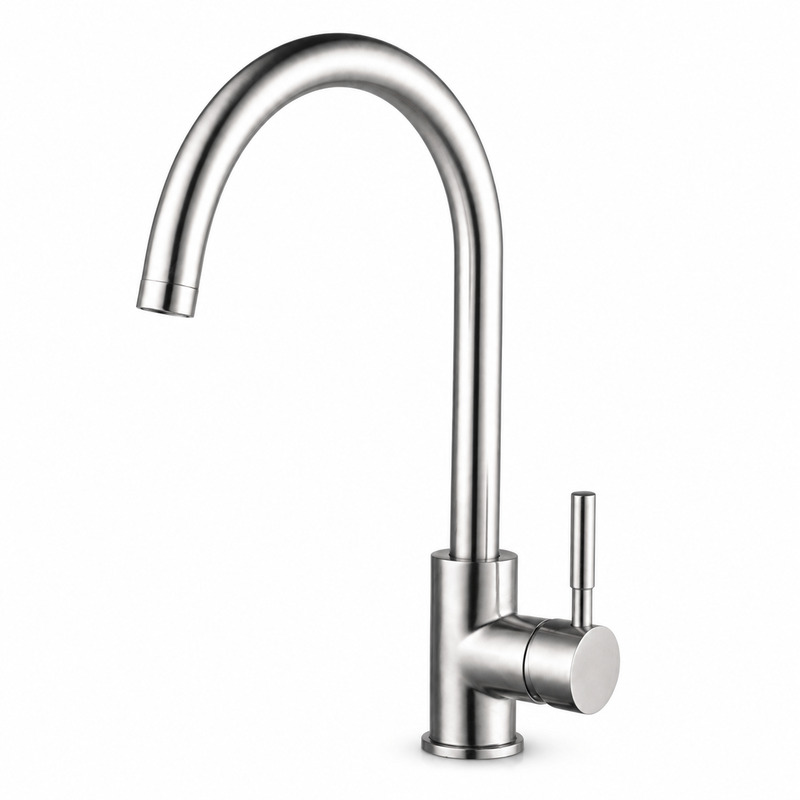
For a faucet, this is why the waterway is the regulated part: the body's inner surfaces, internal passages, cartridges, seals, hoses and aerator screens that water touches on its way through. A beautiful exterior is irrelevant to these rules; an inner component material is decisive.
The North American Family
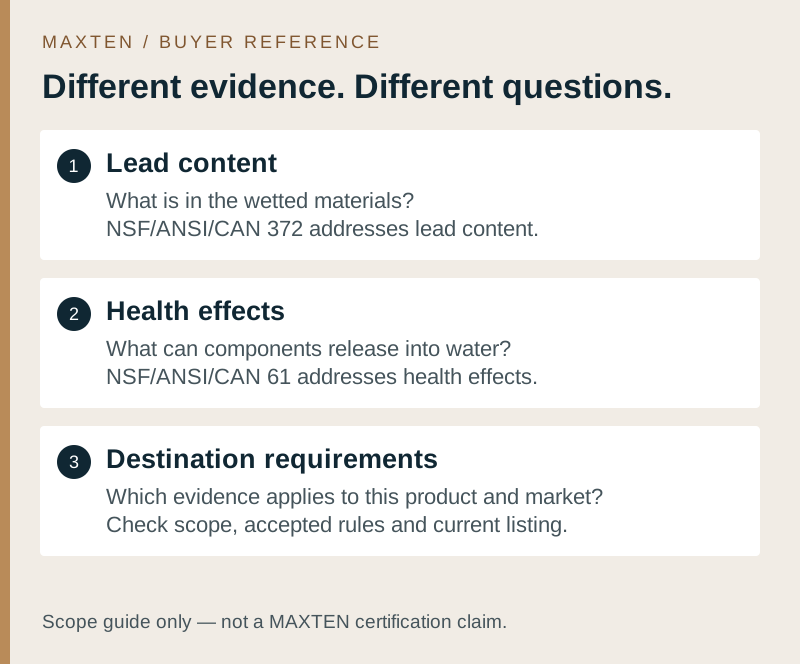
For the United States and Canada, two frequently encountered standards address different issues. NSF/ANSI/CAN 61 covers health effects associated with contaminants that drinking-water system components can release. NSF/ANSI/CAN 372 addresses lead content in relevant components; it is not a leaching test.
These designations do not describe three separate certification bodies. Nor does meeting one standard automatically establish every legal or plumbing-code requirement. Confirm the applicable standards, accepted editions and listings with the destination authority and the relevant certification body. Mexico requires its own market review and is not covered by this US/Canada summary.
References: NSF on Standard 61 and NSF on Standard 372.
The European Family
Editorial review: 14 October 2026. Faucet performance and drinking-water hygiene need separate checks. Standards such as EN 817 for mechanical mixing valves and EN 1111 for thermostatic mixing valves address product performance within their scope. Citing either is not, by itself, a complete water-contact approval or a blanket CE-marking claim.
The EU has adopted a common framework for materials and products in contact with drinking water, with new requirements applying from 31 December 2026. Transitional provisions and existing national approvals affect which evidence is accepted. Confirm the rules, timing and product scope for the destination country and planned placing-on-market date. Countries outside the EU require their own assessment.
References: European Commission drinking water policy , BSI mechanical mixing valve standard and announcement of EU water-contact hygiene requirements.
The Question Buyers Ask Most: "Is It Compliant?"
There is no short answer, and that is the point. Compliance is not a property of a faucet in the abstract; it is a relationship between a specific product configuration and a specific market's current rules. The professional phrasing — with suppliers, with customers, in contracts — is "compliant for market X under rules Y, documented by Z."
For buyers, the verification work reduces to a short checklist. Ask for documentation that names the exact product model (a certificate for "kitchen faucets" generally is worth little), the standard and its version, the testing or certification body and its accreditation status, the certificate holder — which may be the component maker rather than the faucet factory — and the current listing or validity conditions, where applicable. Then check that the details line up with each other and with your market's requirements. Our guide on how to read a test report walks through this verification in detail, including the red flags that separate real documents from decorative ones.
Where the Responsibility Actually Sits
Responsibilities depend on the jurisdiction and the party's role as manufacturer, importer, distributor or other economic operator. They cannot be determined only by the brand name printed on a box.
Agree who supplies technical records, verifies model coverage, maintains required approvals and manages product changes. Contractual allocation of tasks does not remove statutory duties. Resolve the destination-specific obligations with the relevant authority, certification body or qualified adviser before placing the product on the market.
A Note on Materials
An alloy name alone does not establish compliance. A stainless body still forms part of an assembly containing valves, seals, hoses and other wetted components. A brass body likewise requires the correct grade and appropriate evidence. Review the whole waterway and the supplied configuration rather than treating a material label as a certificate.
Our stainless steel versus brass comparison explains material selection; the importing guide places documentation checks in the purchasing process.
About MAXTEN
MAXTEN supplies faucet series for importers, distributors and private-label brands, backed by Risheng Sanitary Ware Factory's manufacturing capabilities since 2002. Our focus is kitchen and basin faucets and related faucet sourcing requirements.
Tell us the destination market and the product configuration so documentation requirements can be discussed before ordering. Contact maxten_mr.lin@maxten.cn or send an inquiry.
Frequently Asked Questions
Why do faucets need drinking water standards at all?
Water contacts internal surfaces, seals and other components before use. Relevant requirements control material composition or the release of contaminants, depending on the standard.
What is the difference between NSF/ANSI/CAN 61 and NSF/ANSI/CAN 372?
Standard 61 addresses health effects from substances released by drinking-water system components. Standard 372 addresses lead content. They answer different questions, and neither alone establishes every market requirement.
Is a faucet compliant in one market automatically compliant in another?
No. Check the exact configuration, destination rules and accepted evidence. EU water-contact requirements are also in transition, with new requirements applying from 31 December 2026.
How can a buyer verify a supplier’s compliance claim?
Match the model and configuration to the documentation. Check the issuer, relevant accreditation scope, standard edition, holder and current listing or validity conditions. Confirm what evidence is accepted in the destination market.
YOUR NEXT SOURCING DECISION
Discuss the right faucet for your market.
Share your product specification, finish and target market with the MAXTEN team.