
Testing & verification
How to Read a Faucet Test Report (and Spot a Weak One)
Learn how to check a faucet test report’s issuer, model coverage, standard edition, results and limitations before relying on it for a purchase.
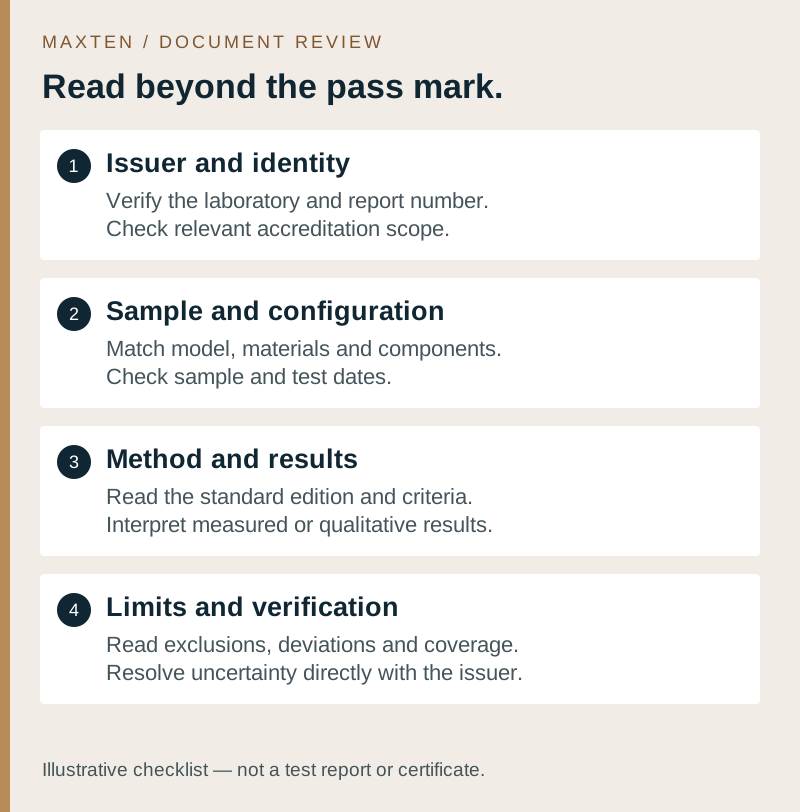
Somewhere in almost every faucet negotiation, a supplier sends a document with a laboratory logo and a table of numbers, and the buyer feels reassured. That feeling is worth exactly as much as the buyer's ability to read the document. Test reports differ enormously in what they actually establish — and in importing, the gap between a rigorous report and a decorative one is where quality disputes, customs problems and product recalls are born.
This guide walks through what a credible faucet test report contains, section by section, and then lists the red flags that separate documents worth trusting from documents worth questioning.
TL;DR
| Section of the report | What to check |
|---|---|
| Laboratory identity | Identifiable issuer; relevant accreditation where required |
| Product identification | Exact model, configuration, photos of the tested unit |
| Standard cited | Correct standard and version for your market |
| Results table | Criteria and results; units for quantitative measurements |
| Scope and notes | What was covered, what was not, any deviations |
| Dates and status | Sample/test dates; current relevance and any listing conditions |
Section One: Who Tested It
Identify the laboratory, report number and issue date. Where accredited testing is required, check the laboratory's current accreditation and scope in the accreditation body's directory. Accreditation for one activity does not automatically cover every test in a report.
Use independently obtained issuer contact details to confirm uncertain documents. The ILAC guidance on accredited bodies explains how to locate the relevant accreditation body. A logo or scanned signature alone cannot establish authenticity.
Section Two: What Was Tested
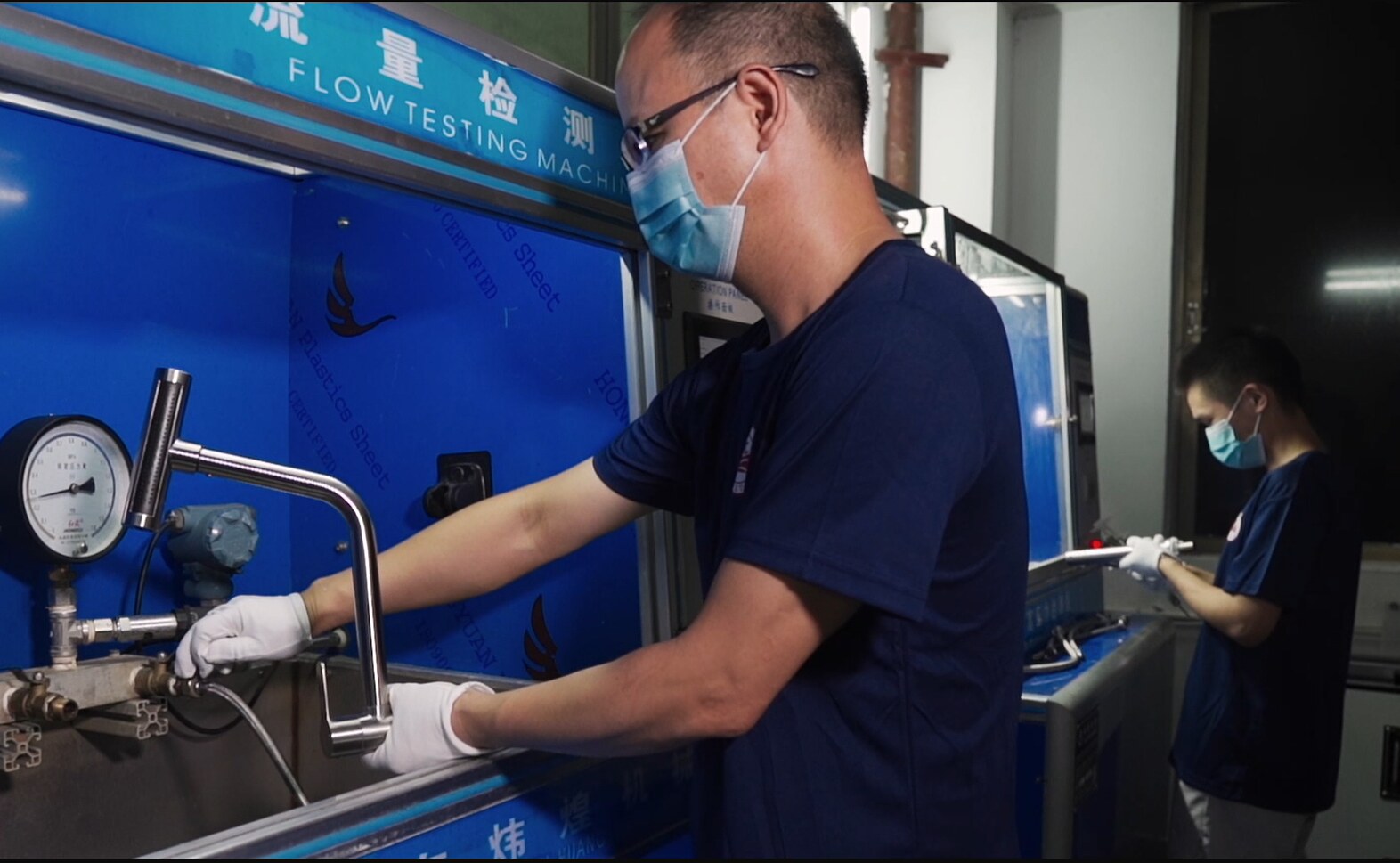
The product description is where weak reports give themselves away first. The report should identify the exact model tested — with a model number, a configuration description, and ideally photographs of the actual unit on the bench. "Kitchen faucet" is not a product identity. If the document cannot tie itself to a specific model and configuration, it cannot protect you, because a supplier can honestly present it while shipping a different product than the one tested. This matters more than buyers expect, since faucet families often share a look while differing in cartridges, hoses and waterway parts — the very parts most tests care about.
Section Three: Against Which Standard — and Version
The standard citation needs two components: the correct document for your market's requirement, and its version or year. Standards are revised; requirements shift between editions; a report against an old version may be entirely genuine and entirely insufficient for your current market rules. Check the version, and check that the standard cited actually addresses what you need it to address — a mechanical performance test does not establish water-contact compliance, and vice versa (our drinking water standards overview explains how those families differ).
Section Four: Results, Not Just Pass Stamps
For a quantitative test, look for the measured result, units, method and applicable acceptance criterion. Where relevant, review measurement uncertainty and the decision rule used for a conformity statement.
Some tests are qualitative: a valid result may be a stated observation or pass/fail outcome without a numerical measurement. Judge the reporting against the test method rather than treating every non-numerical result as suspicious.
A larger numerical margin does not guarantee future production will pass. It is one observation about the tested sample under stated conditions, not proof of batch consistency.
Section Five: Scope, Notes and the Fine Print That Protects You
The most under-read section is the one that defines limits: deviations from the method, conditions that were different from standard, parts of the product not covered, and any statements about what the report does not establish. Good laboratories write these notes carefully, and they are your best defense against over-claiming — by the supplier to you, or by you to your customers. A report that establishes one property of a product does not certify the whole product for all purposes; the notes section is where a careful reader keeps that boundary visible.
The Red Flags List
Follow up on missing pages, unclear sample identification, unexplained document alterations, an absent standard edition or a test scope that does not match the ordered configuration. Quantitative results should have the information needed to interpret them; qualitative tests need clear observations and criteria.
A scanned signature is not automatically fraudulent, and a different report applicant can be legitimate. Verify unexplained differences with the issuer and document the relationship to your order.
Test reports do not necessarily have an expiry date. Their usefulness depends on changes to the product, method and accepted requirements. Certificates and product listings may have separate validity and surveillance conditions.
Verifying Without Becoming a Detective
Verification need not be hostile — professional suppliers expect it. Ask for the full report, not extracts. Ask which models and configurations the scope covers. Where a certification body operates a public directory, check the listing matches the document. And put documentation requirements into the purchase specification itself, so the obligation to provide current, correctly scoped documents is contractual rather than a favor. Our factory verification checklist places document checks among the highest-value steps an importer can take, and our importing guide explains when to agree documentation and inspection requirements.
About MAXTEN
MAXTEN supplies faucet series for importers, distributors and private-label brands, backed by Risheng Sanitary Ware Factory's manufacturing capabilities since 2002. Our focus is kitchen and basin faucets and related faucet sourcing requirements.
Send your required test scope and product configuration when discussing a faucet program. Contact maxten_mr.lin@maxten.cn or send an inquiry.
Frequently Asked Questions
What sections should a credible faucet test report include?
Look for laboratory and report identification, sample details, dates, test methods and standard editions, results against applicable criteria, and limitations or deviations. Check relevant accreditation when required.
What are the red flags of a weak or misleading test report?
Missing pages, unclear sample identity, unexplained alterations, missing method details or scope that does not cover your configuration deserve follow-up. Qualitative pass/fail results and scanned signatures are not automatically invalid.
Why does the standard version matter so much?
Requirements can change between editions. Confirm which edition the destination accepts, including any transition period. The newest publication is not automatically the legally required edition everywhere.
Can I rely on a supplier’s report for a different model in the same series?
Only if the documented scope and the relevant assessment explicitly cover your model and configuration. Similar appearance alone is insufficient; ask the issuer about differences in cartridges, coatings or water-contact components.
YOUR NEXT SOURCING DECISION
Discuss the right faucet for your market.
Share your product specification, finish and target market with the MAXTEN team.