
Flow & components
Faucet Aerators and Flow Rates: A Buyer's Field Guide
Compare aerated, laminar and spray outlets; distinguish flow restriction from pressure compensation and specify compatible, serviceable faucet aerators.

Of all the parts on a faucet, the aerator has the strangest ratio of importance to attention: it is a relatively small outlet component, and yet it shapes nearly everything the end user feels — how the stream looks, how much it splashes, how quickly a pot fills, whether the faucet feels "cheap" for reasons nobody can articulate. For importers, it is also one of the few faucet parts that interacts directly with market regulations, because in several jurisdictions the maximum flow of a faucet is a rule, not a preference.
This guide covers what aerators do, the main types you will specify, how flow requirements differ between markets in principle, and the questions to settle with your factory before an order.
TL;DR
| Question | Short answer |
|---|---|
| What is it? | An outlet device that shapes the stream; aerated versions mix in air |
| Why it matters | Water feel, splash, fill speed and market flow compliance |
| Main types | Aerated, laminar, spray/pull-out spray, flow-restricting |
| Biggest trap | Assuming aerators and threads are interchangeable across markets |
| What to confirm | Aerator type, flow behavior, thread standard and replacement availability — per order, per market |
What an Aerator Actually Does
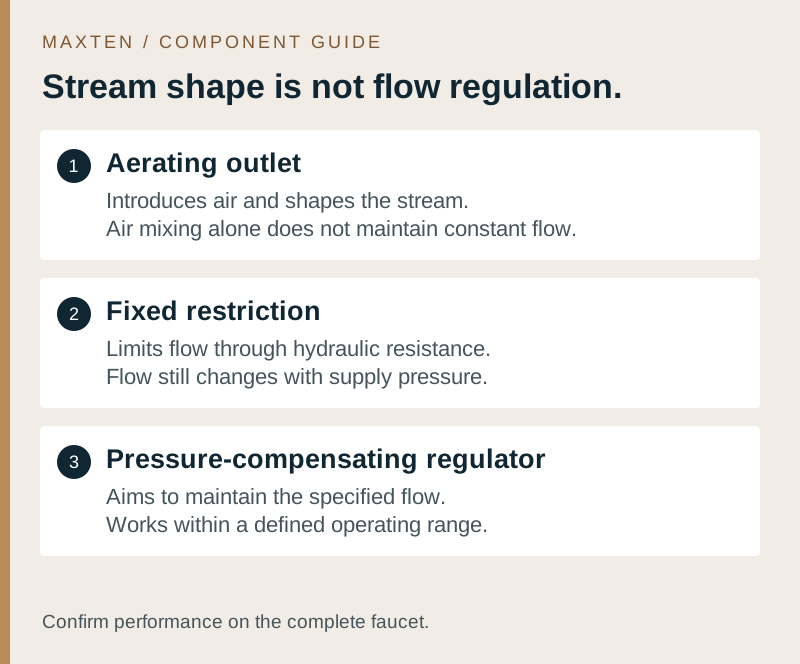
An aerating outlet uses channels, grids or screens to introduce air and shape the water into a fuller-feeling stream. Designs vary; not every outlet consists of stacked mesh screens.
Stream shaping and flow control are separate functions. Adding air does not itself maintain a constant flow rate. A fixed restrictor reduces flow through hydraulic resistance, while a pressure-compensating regulator aims to maintain a specified flow within its rated pressure range.
Choose the outlet and any regulator as part of the complete faucet specification. See the component manufacturer's explanations of aerator water-saving technologies and flow regulators.
The Main Types, and What Each Is Good At
Aerated flow mixes air into the stream for a softer, fuller appearance. Assess splash and noise on the actual installation.
Laminar flow forms a clearer stream without deliberately mixing in air. Whether it splashes more or less depends on flow, outlet height and the receiving surface; it is not universally worse in a shallow fixture.
Spray and multi-flow heads provide different outlet patterns for rinsing and filling. Evaluate mode switching, pattern consistency and operation across the intended supply-pressure range.
Restricted or regulated flow describes flow control rather than one stream appearance. Fixed restrictions vary with pressure; pressure-compensating regulators operate over a defined range. Verify the assembled faucet against the applicable market test conditions and limits. A bathroom specification may not suit a kitchen task.
The Cross-Border Traps
The first trap is thread and housing standards. Aerator housings come in several thread families, and which one fits depends on the faucet design and the market convention it was built for. An importer who assumes a replacement bought at a local hardware store will fit an imported faucet is regularly disappointed. The fix is procedural, not technical: confirm the aerator specification and thread arrangement with the factory in writing, and ask whether matching replacements can be supplied with future orders.
The second trap is scaling and maintenance. Hard water clogs aerator meshes with mineral scale, which shows up in customer reviews as "the faucet got weak after a few months" even when the faucet itself is fine. Provide the correct removal key or other specified tool where required, and clear cleaning instructions compatible with the finish and component. Some concealed designs are not hand-removable. Cleaning guidance can help users restore performance without damaging the outlet.
The third trap is mixing flow specs across a product range. Brands sometimes specify a water-saving aerator on one model and a full-flow aerator on another without checking how they feel side by side in a showroom. End users experience your range, not your spec sheet.
Questions to Put in Writing Before Ordering
Ask the factory to state, per model: which aerator type is fitted; what the flow behavior is across the specified test-pressure range; which removal tool and cleaning method are required; which thread arrangement is used; and whether spare aerators can ship with production lots. If your market has a flow rule, name it explicitly in the purchase specification and ask the factory to confirm the aerator choice against it. These questions cost minutes; their absence costs containers.
Where the Cheap Answer Is the Right Answer
There is no virtue in over-engineering an aerator. For utility and project markets, a standard aerated aerator from a competent supplier is entirely sufficient, and the money belongs in the body and cartridge. Spend attention — not necessarily money — where the rule and the user meet: confirm the flow requirement for your market, keep the aerator cleanable, and make replacements available. That is the whole job.
About MAXTEN
MAXTEN supplies faucet series for importers, distributors and private-label brands, backed by Risheng Sanitary Ware Factory's manufacturing capabilities since 2002. Our focus is kitchen and basin faucets and related faucet sourcing requirements.
Share the required stream type, pressure conditions and destination-market flow requirements. Contact maxten_mr.lin@maxten.cn or send an inquiry.
Frequently Asked Questions
What does a faucet aerator do?
An aerating outlet introduces air and shapes the water stream. Flow limitation or pressure compensation requires the appropriate restriction or regulator; aeration alone is not constant-flow control.
What is the difference between aerated and laminar flow?
Aerated flow deliberately mixes in air and looks fuller or whiter. Laminar flow is clearer and does not deliberately add air. Splash depends on the complete installation and operating conditions.
Do flow-restricting aerators affect user satisfaction?
They can. Check filling speed, rinsing performance and applicable flow limits for the intended task. Test at the specified pressures rather than assuming one configuration suits every market.
Why do aerator threads differ between faucets and markets?
Thread size, pitch, male/female arrangement and concealed fittings vary by design. Record the exact dimensions, compatible replacement and any removal key instead of relying on appearance or a nominal label.
YOUR NEXT SOURCING DECISION
Discuss the right faucet for your market.
Share your product specification, finish and target market with the MAXTEN team.