
MATERIALS & QUALITY CONTROL
SUS304 vs SUS201 Faucets: How Importers Tell Them Apart
SUS304 and SUS201 can look identical in product photos. Learn how importers verify stainless steel grades with traceable records and material testing.
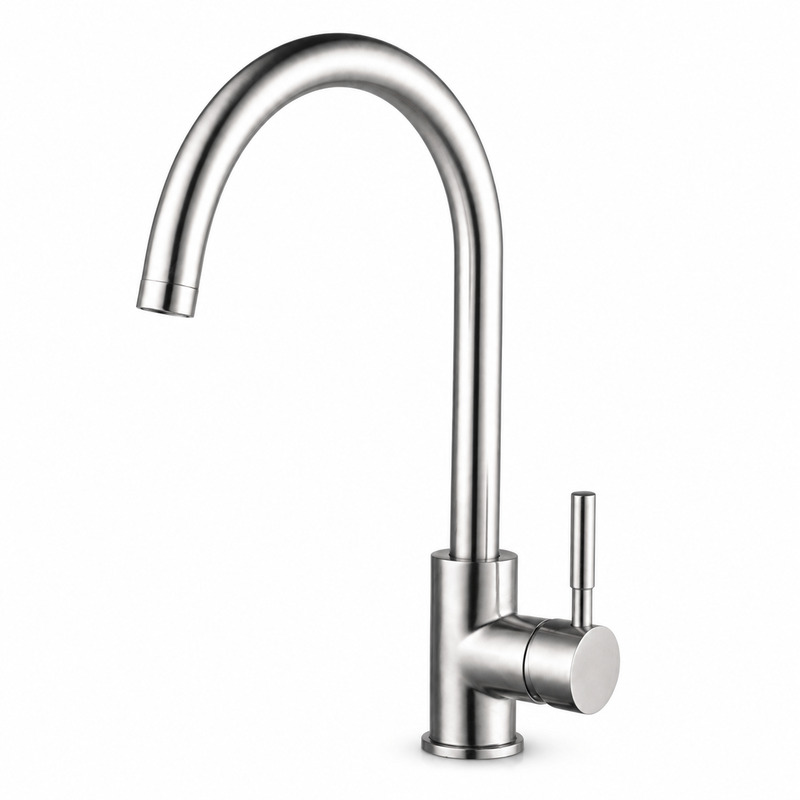
A product photo cannot reliably distinguish a 201 stainless steel faucet from a 304 stainless steel faucet. Their performance can differ in humid or corrosive environments. This article is for importers, wholesalers and private-label brands who specify stainless steel and want to make sure that is what actually arrives — without relying on a magnet.
The Short Answer
| Comparison | SUS304 | SUS201 |
|---|---|---|
| Common name | "18/8" stainless | Manganese-substituted stainless |
| What makes it different | Higher nickel content | Manganese replaces much of the nickel |
| Corrosion resistance in humid / coastal air | Generally better than 201; still dependent on exposure and finish | Generally lower than 304; assess the actual application |
| Appearance in a photo | Identical to 201 | Identical to 304 |
| Price | Higher | Lower |
| Legitimate use | Faucet bodies, wetted components | Dry parts, some decorative components |
| The real risk | Not corrosion-proof; application and compliance still matter | Being supplied as 304 when you ordered 304 |
The core point: the problem is not SUS201 as a material. The problem is substitution. If a supplier specifies 201 openly and you agree, that is a business decision. If 201 arrives on an order that called for 304, that is a quality failure, a compliance risk, and a customer-service problem waiting to happen.
What the Two Alloys Actually Are
Both are austenitic stainless steels. 304 belongs to the chromium-nickel 300 series; 201 belongs to the chromium-nickel-manganese 200 series. The two grades differ in how the austenitic structure is stabilised.
- SUS304 is built around roughly 18% chromium and 8% nickel — the source of the "18/8" nickname. The chromium forms a thin, self-repairing oxide layer on the surface, and the nickel keeps the alloy austenitic, which is what gives it good formability and corrosion resistance.
- SUS201 uses manganese instead of much of the nickel to hold the same austenitic structure. It is a legitimate, standardised grade. Corrosion resistance depends on the full alloy chemistry, surface condition and environment, not nickel content alone. Grade 201 generally offers less corrosion resistance than 304 in demanding wet or chloride-bearing conditions.
Because the two grades can be engineered to look indistinguishable — same finish, same shine, same weight-to-tolerance — the difference only shows up in service, or in a laboratory.
Where the Difference Shows Up in the Field
This is the part that matters for warranty costs.
- Humid and coastal markets. In salty air or persistently damp bathrooms, the lower-nickel grade tends to develop surface rust or pitting earlier. The effect is cumulative and hard to reverse once it starts.
- Wetted and load-bearing components. A faucet body, a spout, any part that stays in contact with water is where the grade matters most. Dry or purely decorative parts are far less sensitive.
- Warranty exposure. A finish failure on a body that should have been 304 tends to surface after the sale, in the end customer's home, far from the factory. By then it is your brand carrying the complaint, not the factory's.
The reverse is also worth saying plainly: in dry conditions and low-stress applications, a properly specified 201 component can serve perfectly well. Material selection is always a trade-off between performance, application and cost — the failure is in the substitution, not in the alloy's existence.
Four Ways to Verify the Grade
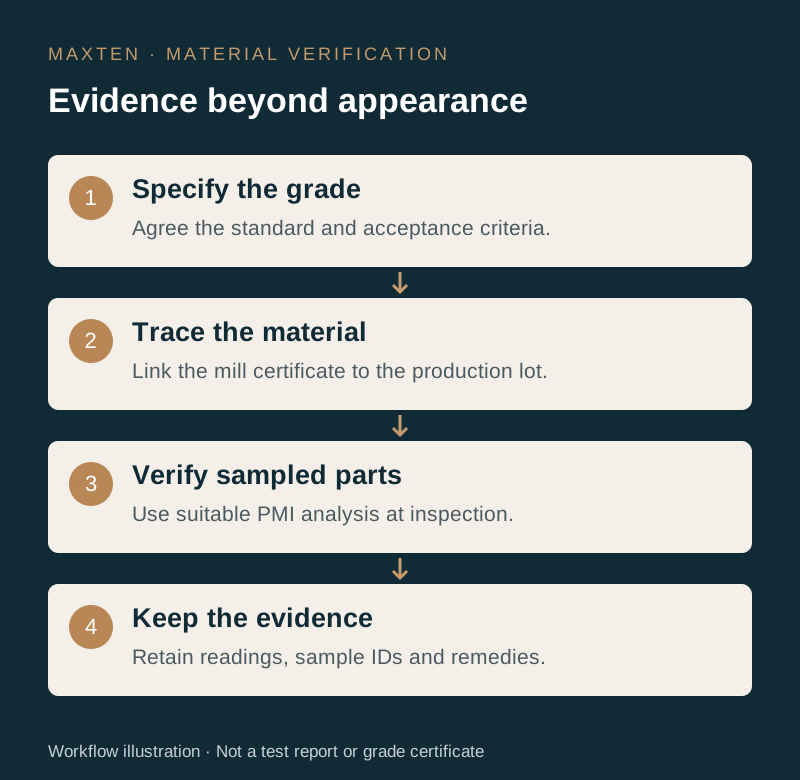
Verification is not one document. It is a chain, and each link closes a different gap.
1. Mill test certificate (MTC), mapped to your order.
The MTC reports the chemistry of the steel the mill delivered. On its own it proves what the mill shipped, not what went into your faucets. Ask the factory to map heat numbers to the specific production batches for your order; an MTC that cannot be tied to your material lot is a piece of paper, not evidence.
2. Positive material identification (PMI) spectrometry at inspection.
A suitably calibrated handheld XRF analyser can help distinguish the grades by measuring chromium, nickel and manganese. Qualified inspection providers can select XRF, OES or another suitable laboratory method, with appropriate surface preparation and sampling. This is the step that closes the loop, because it tests the actual parts you are buying, not the incoming raw material. Build it into your pre-shipment inspection so the result is independent and time-stamped.
3. Corrosion testing as a batch-level comparison.
Accelerated corrosion tests such as neutral salt spray (ISO 9227) are useful for comparing two batches under identical controlled conditions. Read them as a comparison tool, not a prediction of real-world lifespan. Salt spray testing does not identify the alloy grade and does not replace chemical analysis.
4. Contract terms.
Alloy grade, verification method and remedy all belong in the purchase order and the supply agreement. Verification you cannot enforce is a hobby, not a control.
The Magnet Test Does Not Work — Here Is Why
The magnet is the most common piece of folk wisdom in faucet sourcing, and it is the least reliable.
Austenitic stainless steels — both 304 and 201 — are generally non-magnetic or weakly magnetic in the annealed state. Cold working (bending, drawing, machining) can make either of them slightly magnetic, and both can read as essentially non-magnetic when soft. A magnet cannot measure the nickel or manganese content, so it cannot tell the two grades apart.
A magnetic response may indicate a different steel family or a change caused by processing, but it is not a reliable grade identification. If a supplier presents a magnet test as proof of 304, ask for chemical analysis and traceable records.
What This Means at the Negotiating Table
When a "304 stainless steel" quote lands at a price close to a comparable 201 quote, treat it as a verification trigger, not a win. Check whether the quotations use comparable grade specifications, wall thickness, components and finishing. Price differences can also reflect order volume and commercial terms; price alone does not prove substitution.
Practical steps:
- Put the grade and the verification method in the purchase order, not just in an email.
- Make PMI spectrometry part of your pre-shipment inspection on the first order and on any re-sourced item.
- Keep the MTC, the PMI readings and the inspection report together, so the chain is auditable.
- Re-verify when a supplier changes mill, factory or subcontractor — substitution often appears at handover points.
About MAXTEN
MAXTEN is backed by Risheng Sanitary Ware Factory in Jiangmen, Guangdong, whose manufacturing history dates back to 2002. We produce stainless steel kitchen and basin mixers for importers, wholesalers and private-label brands, with OEM and ODM programs.
Discuss written alloy specifications and third-party material verification requirements with our team before placing an order. For samples, MOQ and lead times for your market, contact our team at maxten_mr.lin@maxten.cn.
Frequently Asked Questions
Is 201 stainless steel bad for faucets?
Not inherently. SUS201 is a real, standardised alloy with legitimate uses, such as dry components and decorative parts. The problem is not the alloy itself but substitution — supplying 201 when the order specified 304. Its overall alloy chemistry generally provides less corrosion resistance than 304 in demanding wet or chloride-bearing conditions. Suitability must be assessed for the intended application.
Can a magnet tell 304 from 201?
No. Both are austenitic stainless steels and are generally non-magnetic or weakly magnetic in the annealed state; cold working can make either slightly magnetic. A magnet cannot measure nickel or manganese content. Use suitable chemical analysis to verify the grade.
What document proves which alloy I received?
A mill test certificate (MTC) mapped to the heat numbers used in your production batches, paired with positive material identification (PMI) spectrometry at inspection. An MTC that cannot be tied to your specific material lot is not usable as evidence.
How should I write the alloy requirement into my purchase order?
State the grade explicitly (e.g. SUS304), name the verification method (MTC plus PMI spectrometry at pre-shipment inspection), and set out the remedy if results differ. Requirements that are not written into the purchase order are difficult to enforce.
Related reading: stainless steel vs brass faucets. Explore our kitchen faucets and factory and quality-control overview.
Technical references: worldstainless: stainless steel categories and grades; Thermo Fisher Scientific: alloy analysis and PMI.
YOUR NEXT SOURCING DECISION
Discuss the right faucet for your market.
Share your product specification, finish and target market with the MAXTEN team.